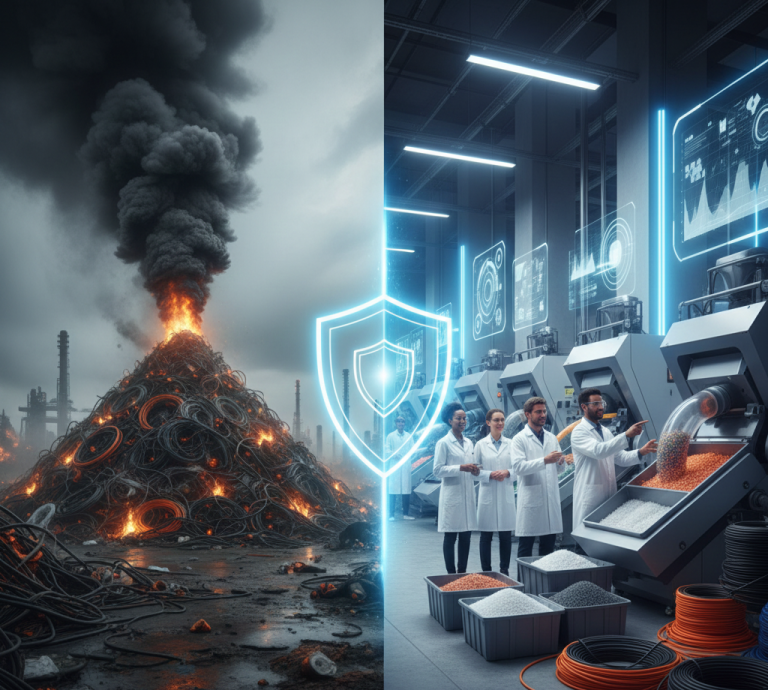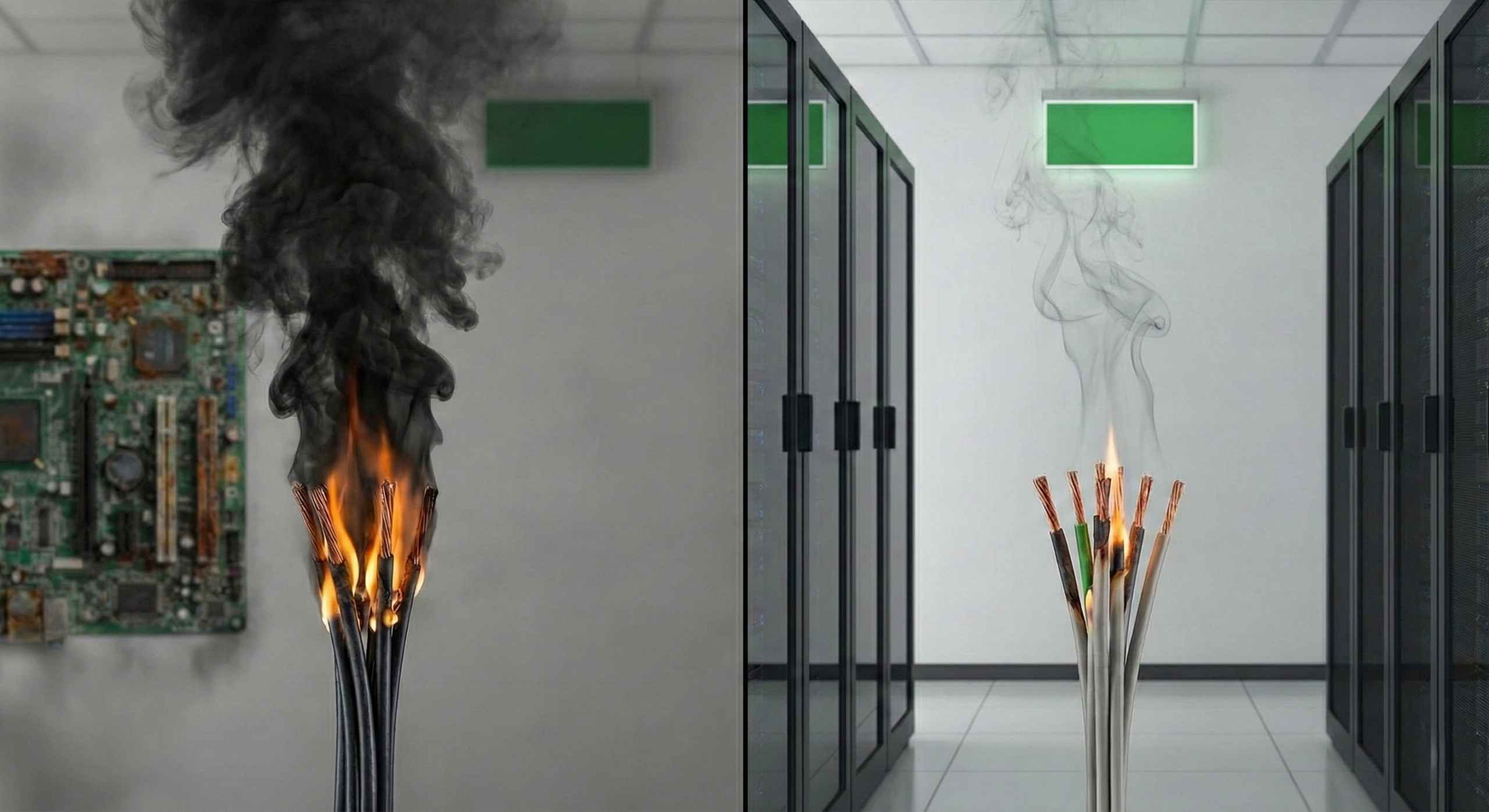
Cables used in the electrical infrastructure of modern buildings are not merely passive components tasked with transmitting energy from one point to another. In a potential disaster scenario, they are one of the most critical elements that either ensure the safe evacuation of the building or, conversely, threaten human life.
The importance of Halogen Free (HFFR) cables in the industry emerges exactly at this point. In the event of a fire, toxic gases that spread within seconds and dense smoke that obscures vision are the primary causes of fatalities, occurring long before the scorching effect of the flames.
Unlike standard PVC cables, Halogen Free technology allows people to evacuate the building safely by preventing the release of toxic gases and keeping smoke density to a minimum during a fire. This feature is not a preference but a technical necessity in all areas of communal living, from hospitals to subways, schools to high-rise residences.
As Delta Tema, in this article, we will not only answer the question “What is HFFR cable?” but also examine the chemical infrastructure of this technology, international standards, and critical mistakes made in projects in depth. We provide high-quality Halogen Free (HFFR) Cable Solutions to ensure safety in your projects.

The Chemistry of Halogen Free Technology and the PVC Difference
For many years, Polyvinyl Chloride (PVC) has been used as the standard insulation and sheath material in the cable industry. PVC became widespread due to its low cost; however, its chemical structure contains a high amount of “Chlorine.” When a fire starts, PVC molecules break down, and the released chlorine converts into Hydrochloric Acid (HCl) gas. A person inhaling this gas is exposed to severe chemical burns within seconds.
Cables termed Halogen Free Flame Retardant (HFFR) or Low Smoke Zero Halogen (LSZH) possess a completely different polymer technology. Halogen elements such as chlorine, fluorine, bromine, and iodine are not used in their production.
Flame retardant substances added to HFFR compounds, such as Aluminum Trihydrate (ATH), undergo a chemical reaction during a fire to release water vapor. As a result, Halogen Free cables do not emit toxic acid gas when burned, and the smoke produced is extremely light in color. According to fire statistics, 80% of deaths are caused by smoke; this technology eliminates precisely this risk.
Corrosive Effect and Property Safety: The Invisible Danger
The importance of Halogen Free cables is generally explained only through “human health,” but there is also a huge “economic protection” dimension to the matter. The acid gas resulting from the burning of PVC cables creates a severe corrosion effect on metals in the environment.
Even if the fire is small, acidic smoke carried through ventilation ducts adheres to the circuits of servers, electronic cards, and sensitive medical devices, melting them. This is why Halogen Free cable use is critical, especially in Data Centers and factories. These cables, which do not emit acid when burned, prevent millions of dollars’ worth of devices unaffected by the fire from becoming “trash.” Insurance companies also mandate these cables in commercial buildings for this reason.
International Standards: When Can We Call a Cable “Halogen Free”?
It is a major mistake to think that every product sold with a “Halogen Free” label provides the same safety level. The quality of a cable must be proven by international IEC (International Electrotechnical Commission) tests conducted in accredited laboratories.
The fundamental tests that a genuine Halogen Free cable must pass are:
- IEC 60754-1 and IEC 60754-2 (Toxic Gas Test): When the cable burns, the amount of halogen acid gas must be less than 0.5% (five per thousand). Additionally, the pH value of the emitted gas must be greater than 4.3 (it must not be acidic).
- IEC 61034-2 (Smoke Density Test): When the cable is burned in a 3×3 meter room, light transmittance must be over 60%. In standard PVC, this rate drops to around 10% (pitch black).
- IEC 60332 (Flame Propagation): Cables must not carry the flame to upper floors like a fuse.
If a cable cannot provide these test reports, it may contain hidden halogens or low-quality filler materials.
Construction Products Regulation (CPR) and Classification
Entering our lives within the framework of harmonization with the European Union, the Construction Products Regulation (CPR) has divided cables into Euroclass classes according to their fire performance. Cables are no longer referred to just as “Halogen Free” or “PVC”, but by classes such as B2ca, Cca.
In high-risk buildings such as hospitals, the “Cca-s1,d1,a1” class is generally required. This coding guarantees that the cable is not only halogen-free but also emits very low smoke (s1) and has minimum acidity (a1). As Delta Tema, we provide products that are fully compliant with CPR classes and possess Declaration of Performance (DoP) documents.
Application Areas and Field Mistakes
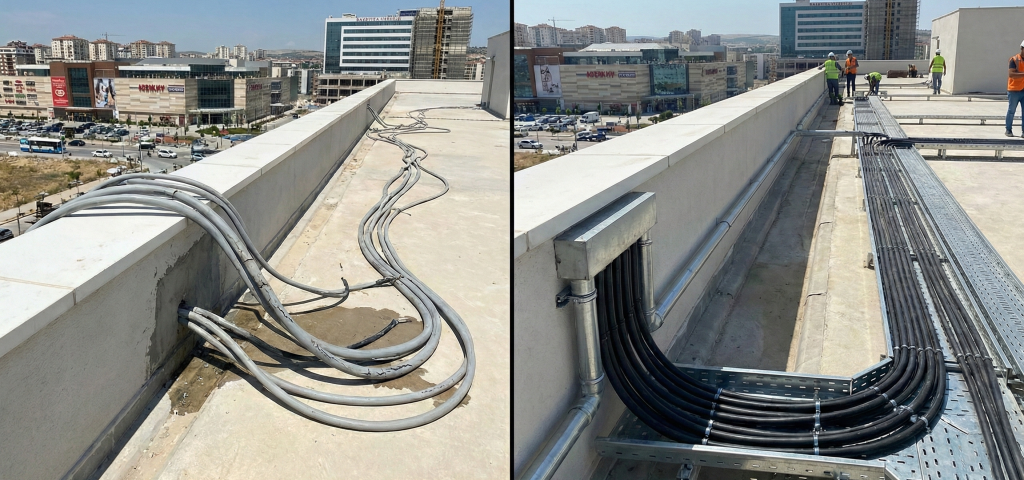
According to regulations; the use of Halogen Free cables is mandatory in places with high human density such as schools, hospitals, tunnels, and shopping malls. However, critical mistakes can be made in the field.
The most common mistake is outdoor use. Standard Halogen Free compounds are not as resistant to UV (Sun) rays and water as PVC. If you use a standard gray cable on the exterior without protection, the sheath will crack over time. Therefore, “UV Resistant” (usually black) special types must be preferred outdoors.
Another mistake is confusing it with FE180 (Fire Resistant) cables. Not every Halogen Free cable carries current during a fire. In fire alarm and pump systems, the cable must be both halogen-free and have the FE180 (functioning under flame) feature.
In conclusion; the use of Halogen Free (HFFR) cable in electrical installations is the cornerstone of modern safe structures. While it is impossible to reduce fire risk to zero, managing its consequences and preventing loss of life is in the hands of engineering. Delta Tema continues to offer the safest solutions in your projects with its technical knowledge. For technical support tailored to your project, you can contact us.
Frequently Asked Questions
What is the fundamental difference between Halogen Free cable and standard PVC cable?
The fundamental difference is the chemical structure. When PVC cables burn, they emit lethal hydrochloric acid gas and dense black smoke. Halogen Free (HFFR) cables do not emit toxic gas or acid and do not create smoke that obscures vision when burned because they do not contain halogens (chlorine, fluorine, etc.). HFFR should be preferred for life safety.
Are Halogen Free cables “fireproof cables”?
No, this is a common misconception in the industry. Halogen Free cables can burn when exposed to fire, but they do not propagate the flame (they are self-extinguishing) and do not emit toxic gas. If you are looking for a cable that must continue to transmit electricity during a fire (alarm, elevator, etc.), the cable must have both HFFR and “FE180” (Circuit Integrity/Fire Resistance) features.
In which buildings is HFFR cable usage mandatory?
According to Fire Regulations; the use of Halogen Free cable is a legal obligation in all structures where people gather in large numbers and evacuation is difficult, such as hospitals, schools, shopping malls (AVM), hotels, cinemas/theaters, airports, subways, tunnels, and high-rise buildings.
Can Halogen Free cables be used outdoors or underground?
Standard gray-sheathed HFFR cables are not as durable against Sun (UV) rays and water as PVC; they crack over time. If they are to be used outdoors, special UV-resistant (usually black colored) Halogen Free cables must be selected, or the cables must be placed inside protective pipes/trays.
What is the benefit of HFFR cables for electronic devices?
Acidic smoke emitted when PVC cables burn corrodes and destroys servers, computers, and sensitive medical devices in rooms not reached by the fire. Since Halogen Free cables do not emit acid, they prevent your millions of dollars worth of electronic infrastructure from becoming “trash” in the event of a fire.